
Defined the intake, analysis, governance, structured-output, and client experience requirements.
CASE STUDY · AI OPERATIONS · KNOWLEDGE SYSTEMS
AI Knowledge Base Gap Analyzer
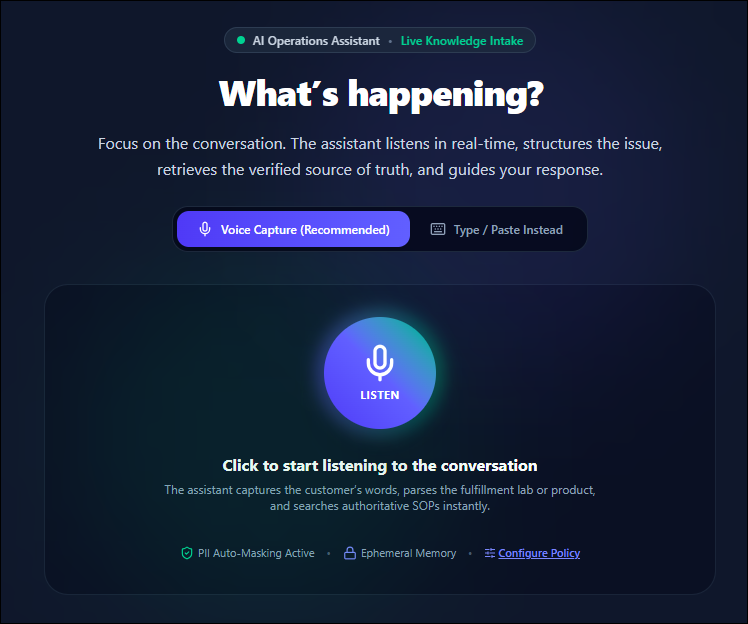
A live portfolio application that turns recurring operational issues into evidence-backed findings, governed recommendations, and structured knowledge-improvement work.
Live demonstration environment: use synthetic or non-sensitive information only. Sample knowledge-center and tracker actions operate inside the portfolio application and do not change a real client system.
THE PROBLEM
Recurring questions are often symptoms of a deeper operational failure.
Support and operations teams repeatedly encounter missing instructions, outdated guidance, conflicting sources, poor findability, unclear ownership, workflow friction, and training gaps. A simple “write another FAQ” response can make the knowledge system worse by adding more content without identifying why the issue keeps happening.
DESIGN PRINCIPLE
Documentation is not automatically the solution.
The analyzer is designed to distinguish among documentation gaps, workflow problems, training needs, UI friction, access issues, ownership failures, source conflicts, and governance weaknesses. The goal is to recommend the smallest correct intervention rather than generate more documentation by default.
MY ROLE
I owned the operating model and used AI-assisted development to accelerate implementation.
I defined the business problem, client workflow, governance rules, knowledge lifecycle, evidence model, authority boundaries, privacy requirements, output contract, acceptance criteria, and desired user experience. AI-assisted development was used to accelerate implementation; I reviewed, tested, debugged, revised, and deployed the resulting system.
Established evidence-versus-authority rules, human approval, sensitivity handling, lifecycle controls, and prompt-injection boundaries.
Migrated the application from its original AI Studio server model to a Cloudflare-compatible architecture and resolved the build/runtime mismatch.
ARCHITECTURE
Client-friendly on the surface; governance-heavy underneath.
User issue + supporting information
→
React / Vite client
→
Cloudflare Pages Function /api/analyze
→
Governed result + human review
The server-side analysis route performs sensitive-data screening, applies the governed analysis rules, calls Gemini when a server-side key is available, and falls back to a deterministic analysis engine when it is not. The browser does not require an exposed Gemini API key.
IMPLEMENTATION STORY
The deployment failure became part of the proof.
- The application began as an AI Studio React/Vite project with an Express
server.tsbackend. - The project was exported to GitHub and connected to Cloudflare Pages.
- The first Pages deployment exposed an architecture mismatch: Cloudflare Pages could build the app, but it would not run the Node/Express server as the application backend.
- The backend was redesigned into a Cloudflare Pages Function at
/api/analyze. - The Vite build was simplified,
distwas made the explicit Pages output, and the old Express server was removed. - The application was redeployed successfully with a server-side analysis route and governed fallback behavior.
This is the kind of implementation work the portfolio is intended to demonstrate: diagnosing the actual platform constraint, changing the architecture, preserving product behavior, and documenting what is and is not connected.
GOVERNANCE
AI analyzes; people retain authority.
The analyzer treats tickets, emails, notes, documents, and other submitted material as evidence rather than automatic truth. Source conflicts are surfaced instead of silently resolved. Sensitive information is screened before analysis. Recommendations do not automatically become authoritative knowledge, policy, or production workflow changes.
Submitted sources may support a finding without being the source of truth.
Authority, publication, policy-sensitive decisions, and material changes remain human-controlled.
The product does not claim integrations or controls as production-connected when they have not been validated.
VALIDATION EVIDENCE
What can be demonstrated today.
React/Vite application deployed through Cloudflare Pages with a Pages Function analysis route.
Server-side screening for common sensitive-data patterns and a stop response before substantive analysis.
The analyzer remains usable without a configured Gemini key through a governed deterministic analysis engine.
Results preserve structured comparison, operational analysis, action planning, dashboard data, and narrative output.
Client-facing language is simplified while authority, privacy, evidence, and governance logic remain in the analysis layer.
Business impact has not yet been measured in a real paid-client environment, so no client ROI or ticket-reduction claim is presented as fact.
CURRENT LIMITATIONS
What this portfolio build does not claim.
- It is not a multi-tenant paid-client SaaS environment.
- It does not claim production authentication, tenant-isolated storage, or subscription enforcement.
- Sample tracker and knowledge-center interactions are portfolio simulations/local application state, not external enterprise integrations.
- Business outcome metrics require real client baselines and post-implementation measurement.
- AI findings require human verification before authoritative or high-impact use.
WHY IT MATTERS
The project demonstrates the system around AI—not only the model call.
The value of the project is the operating architecture: client intake, knowledge governance, evidence controls, human review, structured outputs, deployment, failure handling, and explicit boundaries around what AI should and should not decide.